

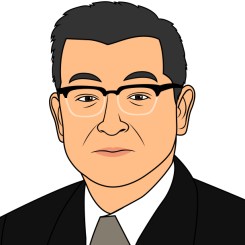
Kaoru Ishikawa was a Japanese organizational theorist, Professor at the Faculty of Engineering at The University of Tokyo, noted for his quality management innovations. He is considered a key figure in the development of quality initiatives in Japan, particularly the quality circle. He is best known outside Japan for the Ishikawa or cause and effect diagram often used in the analysis of industrial processes.
Born in Tokyo, the oldest of the eight sons of Ichiro Ishikawa. In 1939 he graduated University of Tokyo with an engineering degree in applied chemistry. After graduating from the University of Tokyo he worked as a naval technical officer from 1939-1941. Between 1941-1947 Ishikawa worked at the Nissan Liquid Fuel Company. In 1947 Ishikawa started his academic career as an associate professor at the University of Tokyo. He undertook the presidency of the Musashi Institute of Technology in 1978.
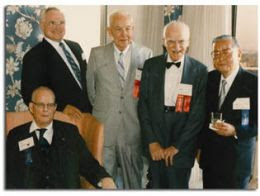
In 1949, Ishikawa joined the Japanese Union of Scientists and Engineers (JUSE) quality control research group. After World War II Japan looked to transform its industrial sector, which in North America was then still perceived as a producer of cheap wind-up toys and poor quality cameras. It was his skill at mobilizing large groups of people towards a specific common goal that was largely responsible for Japan’s quality-improvement initiatives. He translated, integrated and expanded the management concepts of W. Edwards Deming and Joseph M. Juran into the Japanese system.
After becoming a full professor in the Faculty of Engineering at The University of Tokyo (1960) Ishikawa introduced the concept of quality circles (1962) in conjunction with JUSE. This concept began as an experiment to see what effect the «leading hand» (Gemba-cho) could have on quality. It was a natural extension of these forms of training to all levels of an organization (the top and middle managers having already been trained). Although many companies were invited to participate, only one company at the time, Nippon Telephone & Telegraph, accepted. Quality circles would soon become very popular and form an important link in a company’s Total Quality Management system. Ishikawa would write two books on quality circles (QC Circle Koryo and How to Operate QC Circle Activities).
He has received many awards and among them are the Shewhart Medal for outstanding technical leadership in the field of modern quality control and the Order of the Sacred Treasure (Japan) for outstanding technical leadership in the field of modern quality control. He also has been recognized by the ASQ. He has been awarded the Industrial Standardization Prize for writings on quality control, the Nihon Keizai Press Prize and the Grant Award from the American Society for quality control for his education program on quality control.
Dr. Ishikawa is widely recognized as one of the leading authority in quality control techniques and training. His methods have been utilized by Komatsu, Bridgestone and IBM just to name a few.
Kaoru Ishikawa died in 1989 by natural causes at the age of 73.
Resource:
 Ishikawa's Legacy